
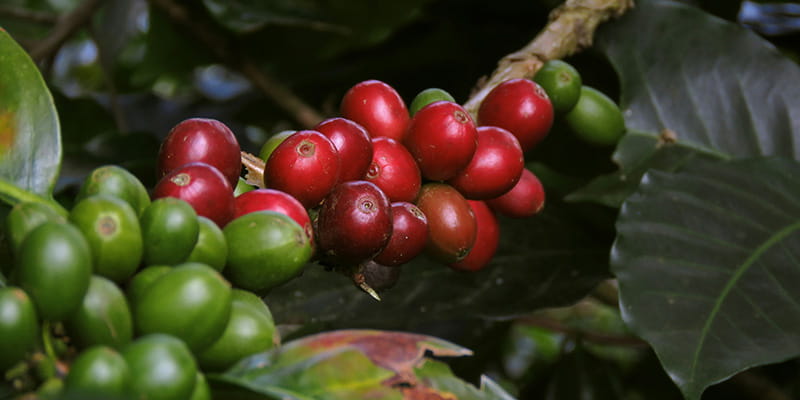
If you’ve ever looked closely at a coffee plant, you might be surprised by what you see. Coffee beans don’t actually grow on the plant as beans at all. They begin their journey inside a small, colorful fruit commonly known as a coffee cherry.
So, what exactly is the difference between a coffee bean and coffee cherry? From flower to fruit and from fruit to bean, coffee goes through a tremendous journey of transformation before reaching its final destination in your cup.
The Flowering Coffee Plant: Where It All Begins
Before our beloved coffee plant bodes its cherries to harvest into delicious coffee, the harvesting season begins with flowering coffee plants. Small white petaled flowers bloom across the nodes of each branch of the coffee plant before falling away to reveal small green coffee cherry pinheads. These cherry pinheads will soon expand into the cherries we know our beans to come from.
Coffees Fruiting Body: The Cherry
A coffee cherry is the fruit of the coffee plant. Starting out green and gradually changing color as it ripens, most commonly becoming red, yellow, or orange depending on the coffee variety.
The cherry is roughly the size of a small grape, although its appearance varies. Beneath its skin is a layer of sweet fruit pulp, followed by several protective layers surrounding the two seeds encased inside.
Those seeds are what we eventually call coffee beans.
When a coffee cherry is ripe, producers harvest it from the coffee plant. The fruit then goes through processing to remove the surrounding layers and clean the seeds inside.
What Is a Coffee Bean?
Despite the name, a coffee bean isn’t technically a bean. It is the seed(s) of the coffee cherry.
Most coffee cherries contain two seeds positioned flat against each other. Once removed from the fruit, these seeds are processed, removing their pulp, dried of their protective honey-like layering, and eventually roasted to be brewed among a multitude of methods.
Before roasting, coffee seeds are often called green coffee. They are usually a pale green or yellowish color and have little resemblance to the dark, aromatic beans we recognize from our coffee bags.
Roasting transforms them dramatically. Heat develops hundreds of flavor and aroma compounds, turning the green seeds into the flavorful and aromatic brown coffee beans we grind and brew.
A Simple Way to Think About It
Think of a coffee cherry much like a peach or another stone fruit.
The cherry is the fruit, while the coffee bean is the seed inside the fruit.
The journey looks something like this:
Coffee plant → Flowering body → coffee cherry → coffee seed → green coffee → roasted coffee bean → brewed coffee
Each stage plays an important role in determining what ends up in your cup.
Why Does the Coffee Cherry Matter?
It might seem like the cherry is simply packaging for the coffee seed, but it can have a significant influence on the coffee-making process.
Once coffee cherries are harvested, producers must decide how to remove the fruit. Different processing methods leave the seed in contact with varying amounts of the fruit and its sugars during drying processes. These change the inherent volume of compounds within the cherry before the final roasting process.
For example, in the washed process, the fruit is removed relatively early before the seeds are dried. In natural processing, whole cherries are dried with the fruit still surrounding the seeds. Other methods, such as honey processing, fall somewhere in between.
These approaches can influence the final character of the coffee, contributing to differences in sweetness, acidity, body, and overall flavor.
What Happens to the Rest of the Cherry?
The coffee bean is only one part of the fruit. During processing, the skin and pulp must be separated from the seeds.
What happens to those materials depends on the farm and processing method. Coffee cherry byproducts can sometimes be composted, used as agricultural material, or turned into other products.
In some coffee-growing regions, the dried fruit itself is also used to make beverages such as cascara, a tea-like drink made from dried coffee cherry skins.
Why Are They Called “Beans” Anyway?
The term “coffee bean” has stuck because the seed resembles other familiar beans in shape. Botanically speaking, however, coffee is a seed rather than a bean.
The terminology isn’t really important when you’re ordering your morning latte—but understanding the difference gives us a better appreciation for how much work goes into producing coffee.
From Fruit to Your Favorite Cup
The next time you open a bag of coffee, remember that those roasted beans started out as seeds inside colorful little fruits growing on coffee plants.
The coffee cherry protects the seed while it develops. Farmers harvest the ripe fruit, producers process it to remove the surrounding layers, and the resulting green coffee is dried, sorted, transported, and eventually roasted.
So, a coffee cherry is the fruit, while a coffee bean is the seed inside that fruit.
That simple distinction is the beginning of a much bigger story—one that connects agriculture, processing, roasting, and brewing all the way to the coffee in your cup.